
ERP rollout
Process, phases & success factors
Unclear responsibilities, inadequately prepared employees, and uncertainty about the system change? The introduction of a new ERP system affects not only IT but the entire company. A carefully planned ERP rollout helps to implement changes in a structured way, create acceptance, and enable a smooth start.
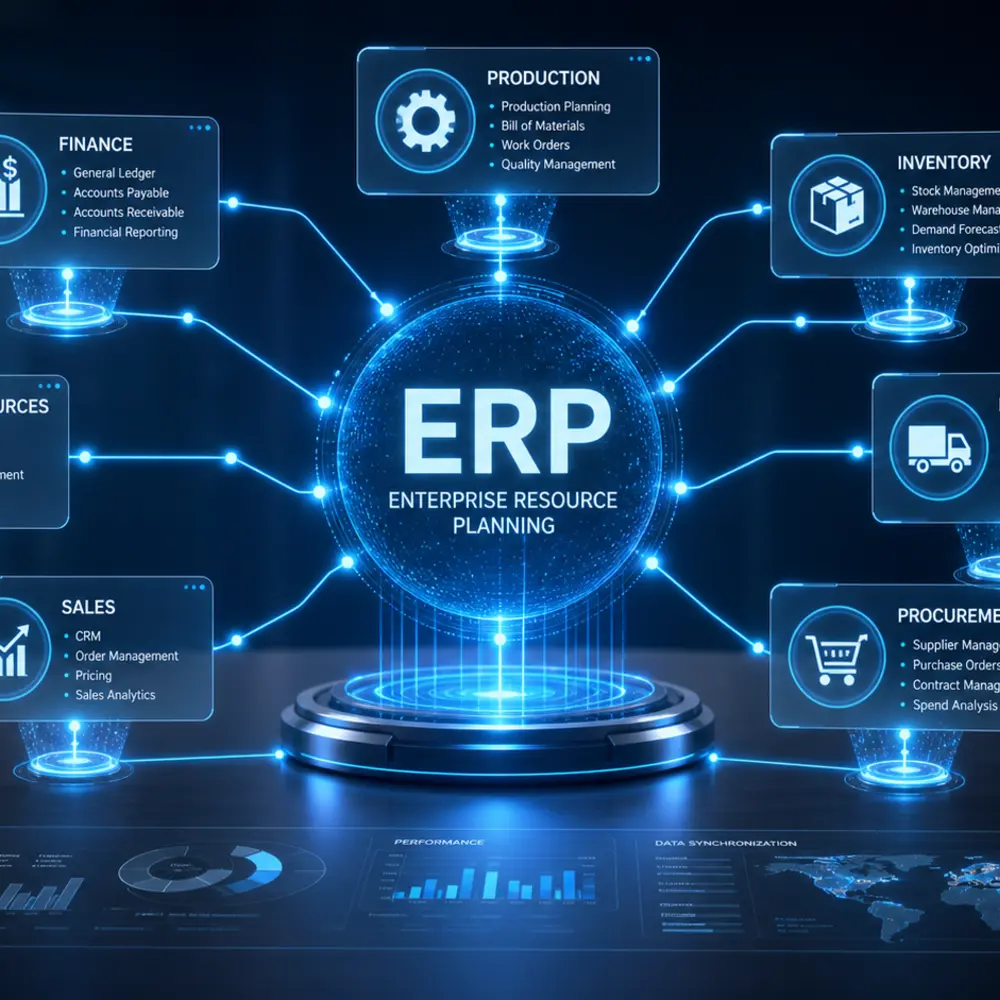
ERP projects often fail for the same reasons as other IT projects: Usually unclear goals, unrealistic deadlines, and lack of coordination among the stakeholders play a role. An ERP migration is, however, considerably more complex. It affects the entire company, its structures, its culture, its productivity.
Therefore it is of great importance to take the right steps from the very beginning. This article explains how you can master the risks of an ERP project and seize the opportunities.
Expectations not clearly defined
Companies implement ERP solutions to improve certain business processes. In addition, they want to be able to query and improve key performance indicators. Fast and reliable analyses should provide important input for strategic decisions and for corporate governance.
But if at the beginning of an ERP project the goals are not defined exactly, it is difficult afterwards to determine whether and which goals were actually achieved by rolling out the ERP.
Therefore, determine exactly how much time and which steps you currently devote to your business processes. Then you can formulate clear expectations. Ideally, the expectations can also be quantified, for example in the form: “We would like to reduce the processing time of orders from currently an average of 15 days to ten days.”
Set benchmarks for success measurement already when documenting your current processes. Try to define the goals as SMART, which means:
- Specific
- Measurable
- Achievable
- Realistic
- Time-bound
ERP Rollout: Thorough Preparation
The following steps are important for the preparation:
- Analyze and document your business processes. Determine where improvements are needed. Carefully consider which processes should be mapped by the new ERP solution and define your requirements.
- Analyze your existing IT landscape. It has probably grown historically and is accordingly fragmented. You surely already have software in use, such as a CRM system or a project management solution. It may be that separate data silos have formed. Consider which older systems should be replaced. For the remaining data, you will need interfaces to the newly introduced software.
- Create a project plan for the ERP rollout, even if you may not yet have an overview of everything today. You can refine the planning after every project progress. In many projects, changes occur afterwards. To prevent the project from getting off track, you should document for every change how it affects the schedule and the budget.
Allow Adequate Time
Take enough time for the preparation. Do not try to save time in the planning phase, but invest as much time as possible in optimal preparation. One or two weeks more preparation time can determine the success or failure of your ERP project. Set the course as early as possible for a smooth rollout.
A rule is: For every month of introduction time you should plan one week of preparation time.
ERP Consulting Is Important
An ERP rollout is not an everyday project. Not every company internally possesses the necessary know-how. Add to this the opaque market. At the latest, after the preliminary selection of ERP providers has been made, ERP selection consulting is appropriate.
There you can benefit from the expertise of the manufacturers. From the providers' references it becomes clear whether they have already successfully implemented ERP migrations in your industry or with companies with similar requirements. If this is the case, it is a big plus for the provider.
If they have also established a structured process for ERP rollout in companies, even better. Otherwise, ask the service team for a fixed contact person who understands your requirements and provides advice in your ERP selection.
An experienced provider can give you a guide for ERP selection. You will then know that they will optimally support you with the preparation and the ERP implementation.
ERP Rollout Is Often Underestimated
An ERP migration is not limited to the technical IT project – it affects the entire operation. It can even lead to a fundamental change in the corporate culture.
All paper-based activities will sooner or later disappear. Employees will have to rethink and relearn. Workflows, data and information will become transparent; they will be available across departments. As a result, numerous processes and everyday aspects of the employees' professional life will change.
Managing Cultural Change
For some employees, it means a fundamental change in their workflows to make their information available company-wide. Due to internal island solutions, important data are often exchanged only within the own department, and not across it.
Others fear becoming redundant due to the ERP change. They do not yet understand that new, more interesting and more qualified tasks will arise – for anyone who is willing to learn.
More efficient processes, better software— for managers that sounds like music, but for many office workers it fuels fear of job loss. It is urgently necessary to manage this cultural change.
Involve Employees
Therefore, a key principle for changes that bring a transformation of corporate culture: Involve your employees early. Also involve the lower levels in communication and decision-making. First, you will not find anywhere else such detailed process knowledge; second, no one will feel left out. Resistance to the intended solutions will come to light openly and will not later manifest as subversive acts of sabotage. Instead, these resistances can be addressed early and dispersed.
Abas ERP Product Brochure
Would you like to see what the Abas ERP software looks like and discover the features it offers?
Our product brochure provides a detailed overview of all ERP functionalities. From materials management and production planning to project management, every key area is covered and explained in depth.

Staffing the project team correctly
All affected levels and functions should be involved in the ERP rollout project team. Ideally, the following people and roles should be on board:
- A member of the management (Executive Sponsor) who ensures buy-in from the leadership level. The Executive Sponsor should also ensure that the ERP rollout has priority.
- An experienced project manager, who must have an understanding of the processes, a view of the big picture, and the necessary decision-making authority.
- The IT Manager, who coordinates the functional aspects between the company, the ERP provider and third parties, and provides the necessary resources.
- End users from the affected departments and functions, for example accounting, manufacturing or development. The users provide functional input and test the software as key users on test installations. They advise on adjustments, document business processes at the user level and advocate acceptance among colleagues. That means they also take on the role of Change Ambassador. This means that these important people are relieved from their other work as long as they take on these important tasks.
Opportunities of ERP rollout
The benefits and opportunities of ERP rollouts are summarized briefly below:
Streamlining
- Manual processes are eliminated.
- Data is used consistently; there are no data islands anymore, but instead a high-quality data organization.
- Automation of routine tasks is efficient and relieves staff.
Improvement of the organization
- Unprofitable or outdated processes are replaced.
- Process quality improves; there are fewer sources of errors.
- The processes are optimized with a view to value creation.
Competitive advantage
- The ERP provides better analytics for decisions and strategic corporate governance.
- Faster processes yield a time advantage.
- Customer satisfaction increases through faster, more personalized service.
- The ERP system can be scaled.
- Some ERP systems offer internationalization and thereby support expansion abroad.